
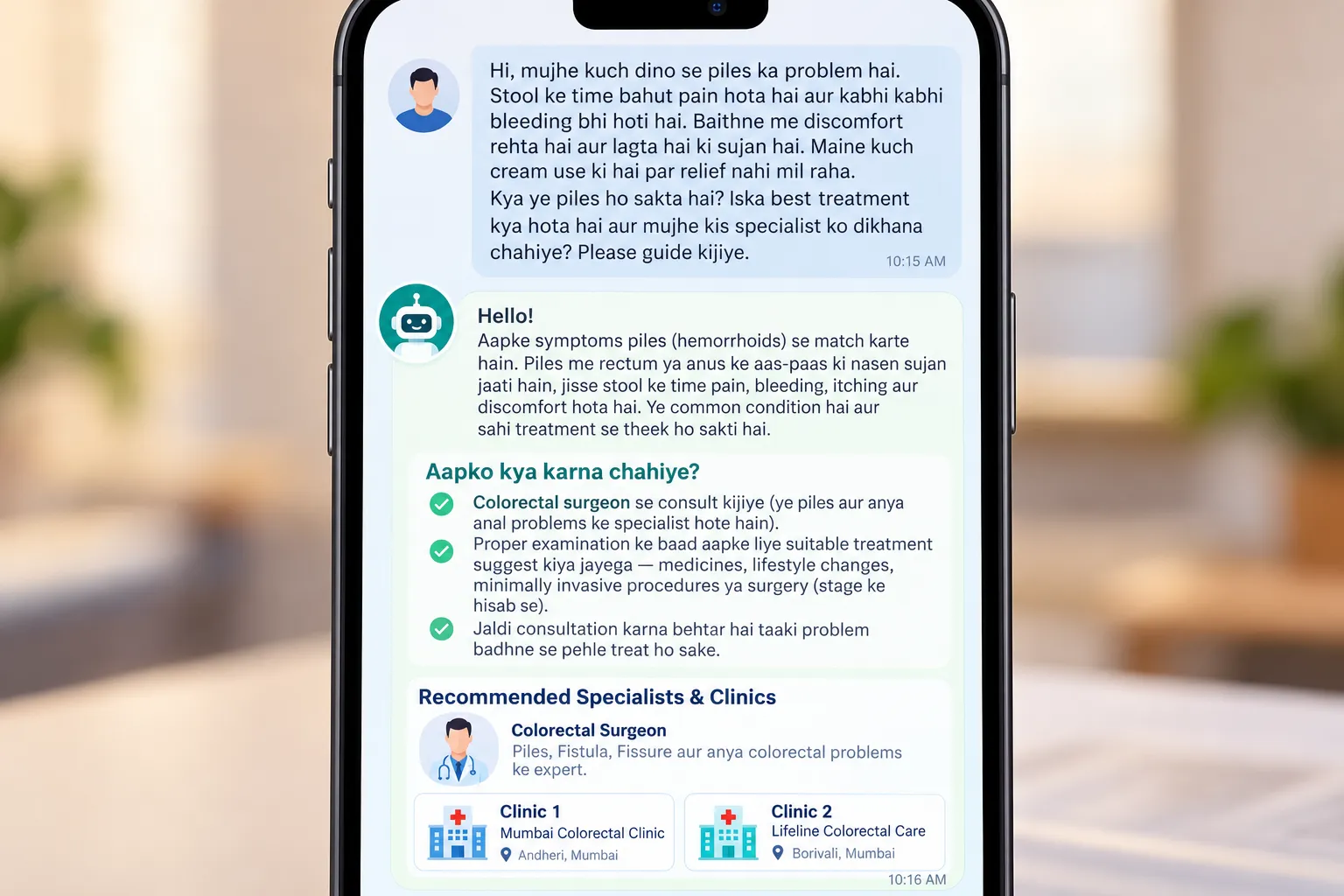
Patients now ask AI long, specific questions about location, cost, pain, timing and trust, often in Hinglish. AI names a doctor only when it can find proof for every part of the question. Know the questions, and you know what to build.
The question got longer, and more honest
On Google, a patient typed “knee surgeon Thane”. On ChatGPT, the same patient types something like this:
“My mother is 68 and diabetic. She needs a knee replacement. We live in Thane, budget is around 3 lakh, and we have insurance. Which surgeon and hospital should we go to?”
Patients tell AI things they would never type into a search bar: age, fears, budget, family situation. AI then looks for a doctor who matches every detail.
The nine kinds of questions patients ask
| What they want | How they ask (real patterns) | What AI checks before naming you | What you need in place |
|---|---|---|---|
| Nearby | “Best gastroenterologist near Powai” | Clinic address, Google profile, locality on your site | An accurate Google profile for each clinic; locality mentioned on your site |
| Quality of care | “Most experienced spine surgeon in Mumbai” | Qualifications, years in practice, procedures, publications, reviews | A detailed bio with credentials and focus areas, consistent everywhere |
| Availability | “ENT doctor available today in Bandra”, “Sunday OPD paediatrician Pune” | Timings, OPD days, booking options | Up-to-date hours on every profile, not just the website |
| Pain and symptoms | “Piles mein bahut dard hai, kaunse doctor ko dikhaun?” | Plain-language content linking the symptom to the right specialist | Patient-friendly pages on symptoms you treat, reviewed by you |
| Cost | “Cost of DBS surgery in India”, “laser piles surgery cost Mumbai” | Honest price ranges and what they include | Transparent cost pages with ranges and inclusions |
| Hospital and insurance | “Cashless knee replacement hospitals in Thane” | Hospital affiliations, TPA and insurance tie-ups | Affiliations listed the same way on every platform |
| Personal preference | “Female plastic surgeon for breast implants”, “Marathi-speaking paediatrician” | Gender, languages spoken, patient groups you see | These details stated plainly on your profiles |
| Second opinion and trust | “Is Dr. Mehta good for fistula surgery?”, “Dr. Mehta reviews” | Review volume, recency, tone, complaints, forum threads | A steady flow of genuine reviews, answered politely |
| International patients | “Best hospital in India for DBS surgery, travelling from Dubai” | International patient services, cost clarity, hospital standards | Pages for overseas patients: process, costs, travel and stay |
Dr. Mehta is a placeholder name used to show the pattern.
What we’ve seen work
- Cost pages win attention. Our page on the cost of DBS surgery in India ranks for that query and brings in enquiries, including from patients abroad. Patients want a number before they want a consultation.
- Preference is a search filter. A female plastic surgeon we work with gets breast implant enquiries from women who specifically want a female surgeon. Stating it clearly is what made that possible.
- Specific beats general. A colorectal surgeon in Mumbai saw enquiries rise once the practice’s content answered the conditions patients actually ask about, instead of general “health tips”.
What this means for your online presence
Every row in that table is a question AI is trying to answer about you. If one cell is empty, such as no timings, no cost guidance or no mention of your hospital, AI picks a doctor whose information is complete.
That is what GEO fixes. See how it works: GEO/AIO for healthcare.
FAQs
Do patients in India really use AI to find doctors?
Yes, and the number grows every month. Patients already use ChatGPT, Gemini and Google’s AI Overviews to understand symptoms, compare costs and shortlist doctors.
Should some of my content be in Hindi or Hinglish?
If your patients describe their problems that way, yes. AI matches the language of the question with sources that speak it.
Should I publish my fees?
Publish honest ranges and what they include. Patients and AI both reward clarity over a “call for price” line.